* All product/brand names, logos, and trademarks are property of their respective owners.
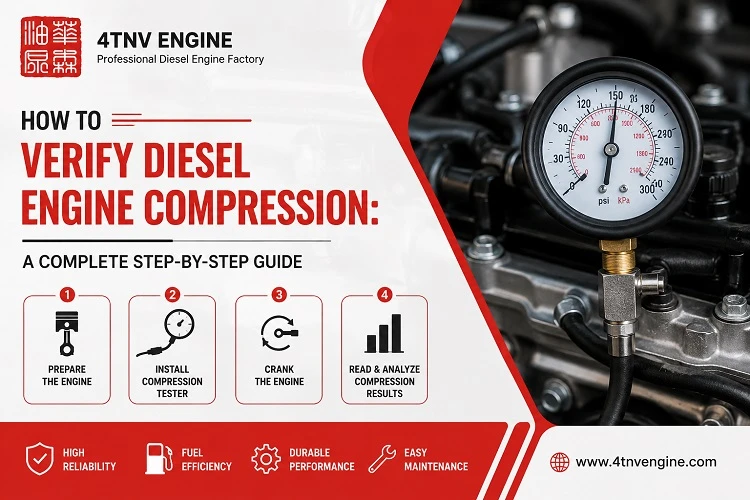
If your diesel engine is losing power, struggling to start, or burning more fuel than usual, low compression might be the culprit. The lifeblood of diesel engines is compression. Diesel engines ignite fuel through the heat generated by compressed air, rather than through a spark plug as in gasoline engines. The performance, efficiency, and reliability all diminish when compression decreases. The good news? Determine the compression of a diesel engine by performing a self-compression check using the proper tools and a step-by-step procedure. This guide will take you through what to do if you operate a fleet, own industrial diesel equipment, or are a workshop owner.
Compression describes the degree to which the air is compressed within each cylinder prior to fuel injection. In diesel engines, this compression is what generates the heat needed to ignite the fuel — no spark required. Diesel engines operate smoothly if the compression is within the correct range. If it drops, even in one cylinder, you'll start to see problems.
Failure or difficulty in starting the engine.
White or black smoke from exhaust
Lack of power when accelerating
Increased fuel consumption
Misfires or rough idling
Excessive oil consumption
Any of the following symptoms mean it's time to do a diesel engine compression test.
Before you start, ensure that you have the appropriate tools. Inaccurate readings may result in expensive errors if the wrong tools are used.
|
Equipment Needed |
Role in the Compression Test |
|
Diesel Compression Test Kit |
Determines the compression pressure of each cylinder |
|
Connection Adapters |
Allows the test kit to fit various engine ports |
|
Basic Hand Tools |
Used to access and remove engine components as needed |
|
Protective Equipment |
Provides safety while performing the test |
|
Log Sheet or Mobile Device |
Captures and stores compression measurements |
|
Battery Support Unit (Optional) |
Maintains reliable cranking performance throughout testing |
Carefully follow the instructions below. Failure of any of these steps can lead to incorrect results or even engine damage.
Start the diesel engine and operate it for 5-10 minutes. Temperature affects the accuracy of compression readings because the metal parts are at their normal working dimensions, the valve seats are properly seated, and the engine oil has reached normal working viscosity in a warm engine.
No fuel injection should be used for testing purposes. Stop the fuel delivery by removing the fuel shutoff solenoid fuse or fuel injection control signal, but do not remove the fuel injection pump. This will help to avoid contamination of the cylinders by fuel that hasn't been burned during cranking.
Use the proper socket to remove fuel injectors one at a time. Compression testing is done via the injector port. On many diesel engines, glow plug bores are also valid and are often used as an access point for compression testing — check your engine's service manual to verify which bores are acceptable for testing the compression of your engine model. Carefully take out removed parts. Exercise caution: After running the engine, the injectors might still be hot.
Have all cylinder pressure released before insertion. Make sure that the cylinder being tested is not at TDC on the compression stroke and that any combustion pressure from the previous stroke has been removed before insertion. Next, choose the proper adapter in your compression gauge kit for the size of the injector port.
Turn the diesel engine (or use the remote starter) and monitor the gauge or have someone else. Allow 4–6 compression strokes per cylinder being tested. Write that number on that cylinder. Make sure the battery is in good condition and charged. Low battery voltage will cause the cranking speed to be slower and will directly influence the accuracy of the compression readings.
Move to the next cylinder, disconnect its injector, connect the gauge adapter, and repeat the test. Write down everything from each reading very carefully. If you want the same thing every time, you have to do it the same way.
If a specific cylinder showed low compression in the dry test, immediately perform a wet test on that cylinder: add a small amount of clean engine oil (about a teaspoon) directly into that cylinder and retest. If the compression increases when oil is added to the engine, then the rings are worn. If it is the same, the valves or the head gasket is likely to be the problem.
The compression ratio for most diesel engines is 275–500 psi depending on the type of engine. Generally, the range is 300 to 400 psi for naturally aspirated engines and over 450 psi for high-performance industrial diesel engines with higher compression ratios. Note that turbocharging increases the charge of the engine when the engine is running but does not change the mechanical compression ratio of the engine, so it is the geometric compression ratio of the engine that determines the result of the static compression test, not whether the engine is turbocharged or not. Refer to the service manual for the appropriate specification for your particular engine type. The values of all cylinders should be within 10% of each other – consistency is as crucial as the values themselves.
Got your numbers? Here are a few ways to help organize them.
|
Result |
Meaning |
Action |
|
All cylinders normal |
Engine healthy |
Continue maintenance |
|
One cylinder low |
Possible ring or valve wear |
Perform further testing |
|
Multiple cylinders low |
Internal engine wear |
Inspect engine thoroughly |
|
Zero compression (one cylinder) |
Major component failure |
Repair immediately |
|
All cylinders low |
Severe wear or overheating damage |
Consider engine overhaul |
To get the most accurate results, always test on a warm engine.
Use a quality diesel compression gauge – cheap gauges will not provide accurate readings.
Make sure the battery is fully charged before cranking.
Test all cylinders during the same session to ensure consistency.
Record outcomes of all tests to identify trends over time.
Use the manufacturer's torque spec when reinstalling injectors.
Compression testing isn't just for fixing problems; it's a valuable proactive method as well. For businesses with fleets, construction equipment, or industrial diesel-powered machinery, regular compression testing can
Identify wear in early stages and prevent it from causing breakdowns
Help plan timely engine overhauls, reducing the risk of cascading mechanical failures
Minimise unexpected repair costs and downtime
Support in making more precise maintenance plans
Extend the working life of engine parts like pistons, rings, valves, and cylinder liners
The majority of industry experts suggest that a compression test on the diesel engine be performed at least annually (or every 500 operating hours in high-load applications).
Compression checking is the first step of any diagnostic procedure for a diesel engine. It provides you with the clarity of what is happening in each cylinder, and it helps you to make informed and cost-effective decisions regarding repair before small issues turn into big problems. Warming up the engine, comparing final readings, etc., are important aspects of this process. When done properly, the compression test can save thousands of dollars in unnecessary engine work and can keep your diesel engines performing at their best. Contact 4tnvengine (XiaMenJin HuaSen Propulsion System) today to get your business diesel engine solutions with reliability and performance. Their professionals can help you acquire the correct performance diesel engines and components, as well as durable diesel engines and components. Call today and let eXiaMenJin HuaSen power your next project.
The normal reading of most diesel engines is between 275 and 400 psi. Consistency is important — all cylinders should be within 10% of each other for a healthy engine.
No, typically not at all. The compression gauge adapter needs to be inserted by removing the injectors or glow plugs. Removal of the injector is the usual procedure, although there are some special tools that enable testing through other ports.
Generally, test once a year. It is recommended that high-use or heavy-load diesel engines be tested every 500 hours or when signs of performance problems are observed.
The most likely causes are worn piston rings, damaged valves, a cracked head gasket, or worn cylinder walls. A wet compression test is used to quickly narrow down the exact cause.

I’m a positive and ambitious person who enjoys learning new things, meeting people, and growing through every experience. I value honesty, confidence, and keeping a balanced outlook in life.
+-------------------------------------------------------------------+ | Top Outer Fac
19 September 2026
Wall corners take more punishment than almost any other surface in a busy commercial building. Troll
17 August 2026
Many industries depend on Hot tapping services in UAE to connect to active pipelines without stoppin
24 July 2026
Be the first to share your thoughts
No comments yet. Be the first to comment!
Share your thoughts and join the discussion below.
.webp&w=3840&q=75)
.webp&w=3840&q=75)