* All product/brand names, logos, and trademarks are property of their respective owners.
As businesses expand, they naturally face increasing operational complexity. Higher customer expectations require more resources, improved systems, efficient workflows, and dependable support functions. The main challenge is achieving growth without letting operational costs rise at the same rate as revenue.
This is where Outsourcing Services provide a strategic advantage. By delegating specific business functions to experienced external teams, organizations can increase capacity, improve efficiency, and allow internal teams to focus on core priorities such as strategy, innovation, and long-term development.
Outsourcing can support a wide range of functions, including customer service, data management, accounting, administrative tasks, technical support, and back-office operations—helping businesses build a more scalable and flexible operating model.
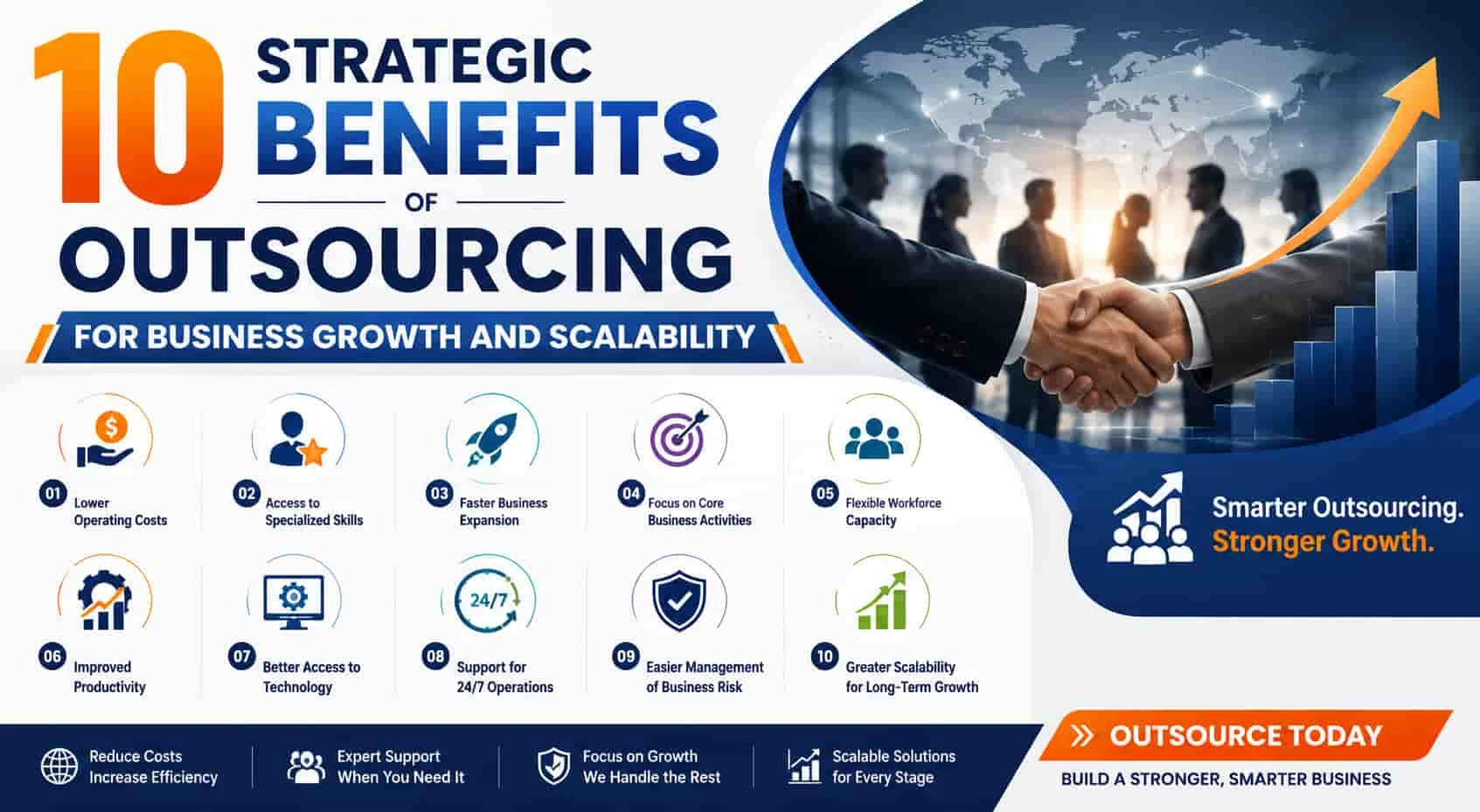
One of the primary advantages of outsourcing is cost reduction.
Running an in-house team involves more than just salaries. Businesses must also cover recruitment, training, employee benefits, office space, equipment, software, and ongoing management costs.
Outsourcing provides access to ready-made teams and infrastructure, eliminating the need to build everything internally. This helps reduce upfront investment and allows companies to maintain more predictable and controlled operating expenses, especially during periods of growth.
As companies grow, they often require specialized expertise that may not exist within their current workforce. Hiring and training new specialists for every function can be time-consuming and costly.
Through Business Outsourcing, organizations can quickly connect with experienced professionals in areas such as customer support, accounting, data processing, technical assistance, lead generation, and administrative services.
This enables faster access to qualified talent without the delays of traditional recruitment processes.
Growth opportunities often arise faster than internal teams can scale.
Sudden increases in customer demand, orders, or service requests can overwhelm existing staff. Hiring additional employees takes time, which may slow down operations and impact service delivery.
Outsourced teams provide immediate support, allowing businesses to handle increased workloads efficiently while maintaining consistent service quality and operational stability.
Internal teams perform best when they focus on activities that directly contribute to business growth. However, repetitive administrative tasks often consume valuable time and energy.
By outsourcing non-core functions, companies can redirect internal focus toward:
Product and service innovation
Sales and marketing growth
Customer relationship management
Strategic planning and expansion
Competitive positioning
This creates a more efficient structure where each team concentrates on its core strengths.
Business demand is rarely constant. Seasonal peaks, marketing campaigns, and market fluctuations can all create temporary increases in workload.
Maintaining a large permanent workforce to handle occasional spikes can be inefficient and expensive.
Outsourcing provides flexibility by allowing businesses to scale support up or down based on real-time needs. For example, customer service capacity can be increased during peak seasons and reduced during slower periods.
When employees are overloaded with repetitive or administrative tasks, productivity often declines.
Outsourcing these responsibilities helps streamline operations and allows internal teams to focus on higher-value work. External providers typically rely on structured workflows, performance tracking, and standardized systems to ensure consistent output.
This results in better efficiency, improved time management, and higher overall productivity across the organization.
Modern business operations rely heavily on technology, but implementing and maintaining advanced systems can be expensive and complex.
Outsourcing providers often already use established tools such as:
CRM systems
Communication platforms
Data processing software
Automation tools
Reporting dashboards
Workforce management systems
Quality assurance tools
By partnering with them, businesses can benefit from these technologies without bearing the full cost of ownership, maintenance, and upgrades.
Today’s customers expect fast, reliable responses at any time, regardless of time zones or business hours.
Outsourcing makes it easier to provide extended or even 24/7 support by utilizing teams across different regions and shifts. This is especially valuable for global businesses serving customers in multiple markets.
Improved availability leads to faster response times and a stronger overall customer experience.
Business expansion often requires significant investment in hiring, infrastructure, and technology. These commitments can increase both financial and operational risk.
Outsourcing offers a more flexible approach by allowing companies to scale operations without immediately committing to long-term internal investments.
It also supports market testing, pilot programs, and temporary demand surges while keeping costs manageable.
However, success depends on choosing reliable partners and clearly defining expectations around performance, security, communication, and service quality.
Scalability is essential for long-term success.
As organizations grow, they need systems that can expand without constant restructuring or disruption. BPO Solutions help achieve this by providing on-demand access to additional resources and operational support.
Instead of continuously hiring and reorganizing internal teams, businesses can scale specific functions externally as needed. This creates a more adaptable and growth-ready operating model.
Outsourcing delivers the best results when applied strategically. Businesses should first identify tasks that are repetitive, resource-intensive, specialized, or non-core to their operations.
When selecting a provider, companies should evaluate:
Industry experience and expertise
Service quality and capabilities
Communication processes
Data security standards
Scalability options
Pricing structure
Performance tracking systems
Reporting transparency
Clear expectations should be established from the beginning, including responsibilities, performance metrics, and communication guidelines.
A well-structured outsourcing strategy ensures that businesses gain not only cost savings but also improved efficiency, flexibility, and operational strength.
Business growth should create opportunity—not operational strain.
As demand increases, outsourcing provides a practical way to expand capacity while maintaining efficiency and control. It supports cost optimization, access to expertise, improved productivity, extended service coverage, and long-term scalability.
However, the greatest value comes from using outsourcing strategically. Companies should carefully choose which functions to delegate while keeping core strategic activities in-house.
With the right approach and the right partners, outsourcing becomes a powerful tool for building a more flexible, efficient, and scalable business prepared for sustainable long-term growth.

No bio available yet.
A jewellery website can attract strong organic traffic and still generate fewer inquiries or sales t
1 October 2026
A car can remain useful for many years, but there comes a point when keeping it on the road no longe
22 September 2026
Selling an unwanted car in Brisbane can raise one main question: how much is it worth? There is no f
22 September 2026
Be the first to share your thoughts
No comments yet. Be the first to comment!
Share your thoughts and join the discussion below.