
* All product/brand names, logos, and trademarks are property of their respective owners.
Before the Essentials hoodie, there were other hoodies. Several of them. A couple from sportswear labels, one from a high street brand that seemed like good value at the time, one older one that had been around so long nobody really questioned whether it was still earning its place. A normal wardrobe situation. Hoodies accumulate. Most people have more than they reach for regularly.
None of them were bad exactly. They did what hoodies do — kept you warm, looked fine, got worn on the days when nothing else seemed right. But none of them generated any particular feeling. You put them on, and you were wearing a hoodie. That was the beginning and end of it. Not a complaint. Just the baseline of what hoodies had always been.
The Essentials hoodie arrived, and the baseline moved. Not dramatically, not in a way that was obvious on day one. But over weeks of wearing it and occasionally reaching for one of the others and noticing the difference — the weight, the fit, the way it sat — something shifted. The others started seeming fine in a way that fine had never seemed before. Fine as in: not quite right. Not quite this.
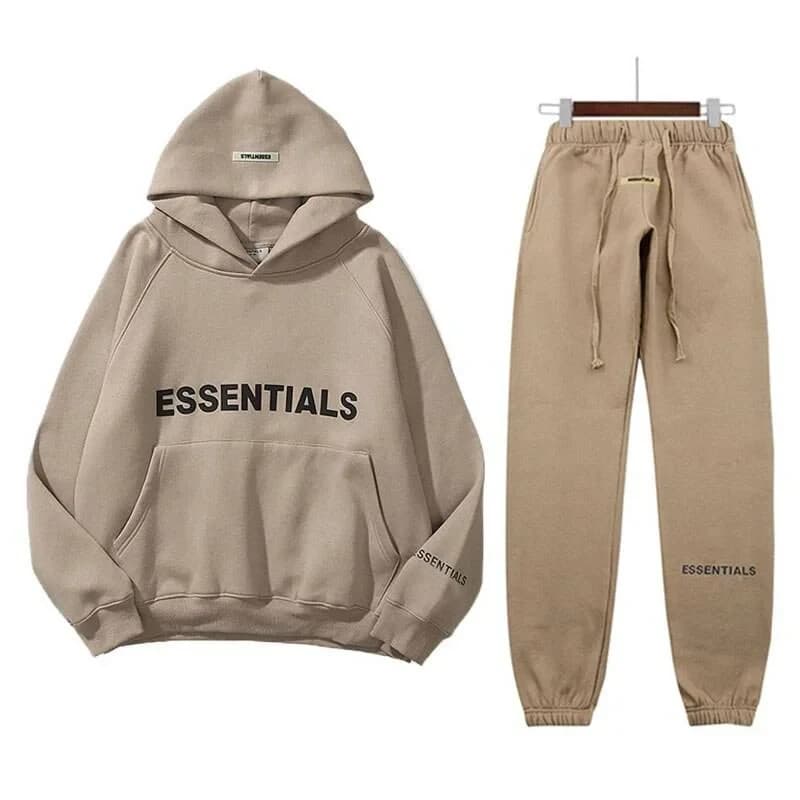
Pick up the Essentials hoodie and pick up most other hoodies at a similar price point, and the difference is immediate. The Essentials is heavier. Not marginally — noticeably. The cotton fleece has a density to it that feels like it means something before you've even put it on. You notice it the moment you pull it off a shelf or out of a bag.
After wearing the essentials for a few months, picking up one of the previous hoodies felt like picking up something unfinished. Like something that had been made to look like a hoodie rather than made to be one. That sounds harsh, and it's not meant as a verdict on those other pieces individually — it's just what happens when your reference point changes. The weight recalibrates your expectation of what a hoodie should feel like. Everything below that new reference point feels like it's missing something.
The Essentials hoodie sits on the body in a specific way. Dropped shoulder, relaxed chest, a length that hits the hip without overshooting. None of these are revolutionary design decisions individually — but together, executed consistently, they create a silhouette that looks right in a way that's hard to go back from once you've worn it for a while.
The previous hoodies in the wardrobe weren't cut this way. Some were fitted in places the Essentials isn't. Some had shoulder seams that sat at the actual shoulder point rather than below it, creating a different — tighter, more sportswear-adjacent — visual effect. Perfectly reasonable cuts for what they were. Just not what the Essentials had established as the reference point for how a hoodie should sit. Mixing stussy streetwear with Essential Hoodies is common among young fashion enthusiasts.
Logos on hoodies used to feel like a secondary consideration. The hoodie is the thing; the logo is just what identifies it. Fine either way — big logo, small logo, no logo, whatever. Then the Essentials hoodie demonstrated that the logo is not actually a secondary consideration. The scale, the placement, the way it reads in context — these things change how the whole piece looks and whether it works across different outfit situations.
The rubberised text on the Essentials chest is small enough that it doesn't lead the outfit. It doesn't announce itself. It sits there as a detail rather than a statement — which means the hoodie can work in more contexts than something carrying a larger or more prominent logo. You can put it in situations where a louder brand identifier would feel wrong and it just doesn't create that problem.
There wasn't a clearout. Nothing got thrown away or donated in a moment of wardrobe rationalisation. The other hoodies are still there, technically. They just stopped being the answer to the question "what am I wearing today." The Essentials hoodie became the answer to that question most days when a hoodie was the right call — and when it wasn't available because it was in the wash, the decision between the remaining options felt like a downgrade rather than a choice.
That's a specific kind of wardrobe problem that good clothing creates. Not a bad problem. But a problem. The piece you love most makes everything around it less satisfying by comparison — not because the other things got worse, but because your sense of what's possible shifted upward. You start noticing what's missing from the alternatives rather than appreciating what they have.
Once you own an Essentials hoodie for long enough, buying other hoodies becomes a different kind of decision. Not impossible — there are still specific situations where a different piece makes sense, a specific aesthetic need that the Essentials doesn't serve, a price point that rules out anything comparable. But the default reach for a cheap hoodie because it'll do the job stops feeling like a neutral choice. It feels like settling.
That shift changes the economics of buying hoodies. Fewer purchases, higher price point per purchase, longer time between purchases because the thing you bought last time is still exactly what you want. Counterintuitively, the expensive hoodie probably costs less over three years than the cycle of cheaper alternatives it replaced — because the cheaper ones were being bought more frequently and wearing out or disappointing faster.
The weight, the fit, and the understated branding together establish a reference point that most other hoodies at similar or lower price points don't meet. Once that reference exists from regular wear, the gap between the Essentials and alternatives becomes harder to ignore. The other hoodies don't get worse — the expectation of what a hoodie should be moves somewhere they can't follow.
Over a long enough timeframe — yes, usually. The construction holds up through regular wear in ways cheaper hoodies don't. The fit stays right through washing where cheaper fleece degrades faster. The resale value holds in a way that most alternatives don't. The upfront cost is higher but the cost per wear and cost per year of use typically works out more reasonable than it looks at the point of purchase.
No need to be dramatic about it. Most people find the other hoodies just stop getting reached for naturally — they don't disappear, they just occupy a different role. Emergency backup, garden hoodie, something to wear when the Essentials is in the wash and you don't want to risk it. They find their place without requiring a formal decision about whether they deserve to stay.
It stops them buying cheap ones impulsively — yes, broadly. The standard it establishes makes the "this'll do" purchase feel less satisfying than it used to. What tends to replace the pattern of frequent cheaper purchases is either fewer purchases overall or a second Essentials in a different colourway. Neither outcome is particularly bad.
Most people describe it happening somewhere between one and three months of regular wear. Not a sudden shift — gradual. You notice the other hoodies getting chosen less. Then you notice the gap in quality when you do wear them. Then at some point the Essentials just becomes the answer to "what am I wearing" on hoodie days without requiring any particular decision.

Samrasadia is a creative content writer who enjoys producing engaging, informative, and easy-to-read articles and guest posts. With a focus on originality, research, and clear communication, Samrasadia creates valuable content across a range of topics.
Love has always found ways to express itself through small, thoughtful gestures. In Pakistan, one ge
16 September 2026
Your custom embroidery project deserves to look amazing. Whether you are creating branded uniforms f
1 September 2026
Fashion trends come and go, but some styles remain popular because they offer something people truly
17 August 2026
Be the first to share your thoughts
No comments yet. Be the first to comment!
Share your thoughts and join the discussion below.